
Process and documentation
How product moves through a pork cutting plant, and what an audit checks
In an EU pork cutting plant, product passes between raw-material reception and dispatch through chilled holding, cutting and boning, selection, packing, cold storage and loading. This page sets out what each step exists to control under EU meat hygiene law, what a plant audit examines, and what to send when you want to ask about documentation or a visit.
The regulatory framework behind each step
Every establishment placing fresh pork on the EU market works to the same body of law. These are the instruments a buyer’s quality department asks about, and what each one governs.
Reg (EC) 852/2004
General hygiene. Article 5 requires a permanent procedure based on HACCP principles; the Annexes set the conditions for premises, water, waste, pest control and personnel.
Reg (EC) 853/2004
Specific rules for meat. Article 4(2) requires approval of the establishment by the competent authority; Annex II Section I governs the identification mark, which carries that approval number; Annex III Section I sets the temperatures meat must hold during cutting, storage and transport.
Reg (EC) 178/2002 and (EU) 931/2011
Traceability. Article 18 of 178/2002 sets one step back and one step forward; 931/2011 fixes the information that must accompany food of animal origin, including the reference identifying the batch and the date of dispatch.
Reg (EC) 2073/2005
Microbiological criteria. Food safety and process hygiene criteria, the sampling frequencies that go with them, and the action required when a result falls outside the limit.
Implementing Reg (EU) 2015/1375
Trichinella, at the slaughter stage. Commission Implementing Regulation (EU) 2015/1375 lays down the rules for official controls for Trichinella in meat. While a result is pending, a carcase may be cut into no more than six parts, in a slaughterhouse or in a cutting plant on the same premises, and only where full traceability is guaranteed.
Reg (EU) 1169/2011 and Implementing Reg 1337/2013
Consumer labelling. 1169/2011 applies to food intended for the final consumer or for mass caterers (Article 1(3)): mandatory particulars, storage conditions and, for frozen meat, the date of freezing (Annex III). At that same stage, 1337/2013 requires “Reared in” and “Slaughtered in” on fresh, chilled and frozen pork.
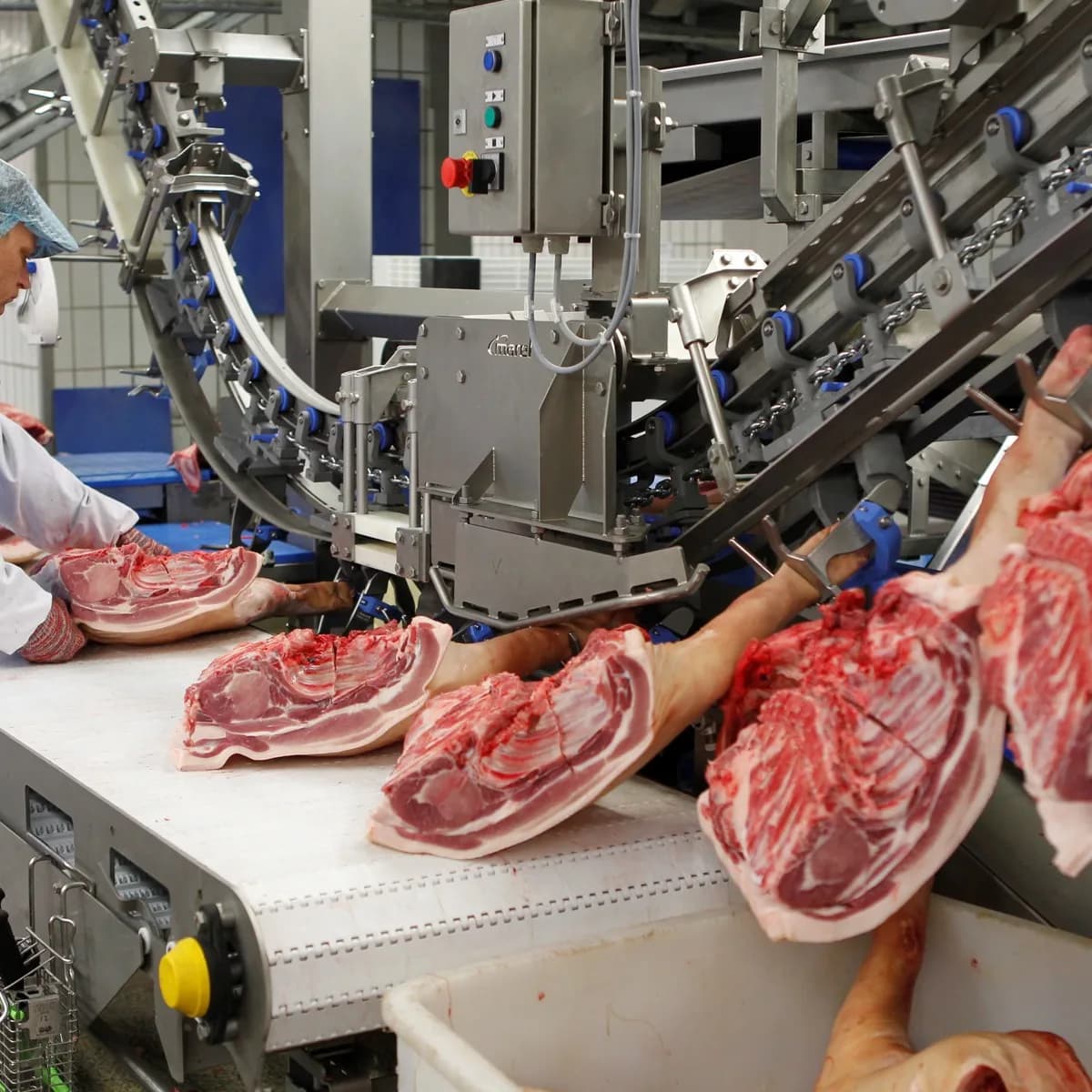
From reception to dispatch
This is the order of operations in a pork cutting plant and the control each step applies. Capacity, line configuration and equipment are matters to settle against a specific requirement, not to publish on a web page.
- Raw material receptionIncoming meat is checked against its commercial document and its identification mark, its temperature verified on arrival and its batch identity recorded before acceptance: the step-back link Article 18 requires.
- Chilled holdingMeat is held at not more than 7 °C and offal at 3 °C, and passes into the cutting hall progressively as it is needed, as Reg (EC) 853/2004 requires.
- Cutting and boningThe meat itself has to stay at or below 7 °C throughout cutting, boning, trimming and slicing; the rule sets a cutting-room ambient of no more than 12 °C, or a system of equivalent effect.
- Selection and trimCuts are worked to the specification set for them: bone-in or boneless, rind on or off, fat cover, trim measurements, and the lean-to-fat ratio fixed for trimmings.
- Packing and markingReg (EC) 853/2004 requires meat leaving an approved establishment to bear the oval identification mark; beyond that, the carton carries the batch reference on which traceability depends. Packing configuration itself is settled against a specific requirement.
- Cold storageChilled or frozen holding under monitored temperature, with stock identified and rotated by batch so that a consignment can be reconstructed afterwards.
- Loading and dispatchLoading at the temperature the product’s condition requires, with the commercial documents that travel with the consignment. Movement between Member States generally travels on those documents alone; a third-country destination calls for the official certificate agreed for that market, issued by the competent authority through TRACES NT.
What a plant audit looks at
A second-party audit before contracting covers much the same ground as a certification audit. Knowing the list makes it easier to say in advance what evidence you need to see.
Approval and scope
An audit starts with the establishment approval number, the activities and species its scope covers, and the authority that issued it. Article 148 of Reg (EU) 2017/625 obliges each competent authority to keep a public list of approved establishments, so scope can be checked at source.
HACCP plan and control-point records
The hazard analysis, the control points drawn from it, the critical limits set at each, and the records showing they were monitored and verified.
Temperature records
Chill rooms, cutting hall, cold store and loading bay, with probe calibration certificates and evidence of what happens when a reading goes out of limit.
A traceability exercise
Taking one carton and reconstructing it back to the incoming batch and forward to every consignee, with a mass balance, inside the time limit your standard sets.
Sampling and foreign-body control
The microbiological sampling plan and its results, surface swabs verifying sanitation, and the registers behind blade, glass and brittle-plastic control.
Non-conformance and recall
How a deviation is recorded, corrected and closed, and a tested withdrawal and recall procedure with the contact chain it depends on.
Documentation a buyer can ask for
Most of this identifies a specific consignment or is commercially sensitive, so it belongs in a buyer’s file rather than on a web page. Which of it applies depends on the product and the destination market.
- Technical data sheet What a data sheet covers for one of the 80 coded specifications: family, HS heading, condition and preparation.
- Approval and scopeAsk in writing, before contracting, whether an approval applies to the supply and what activities it would cover.
- Certification documents A certification standard is named on this site only where a current certificate supports it. Ask which certification is relevant to your supply.
- Traceability procedure How batch identity is carried under Article 18, and what a buyer can ask for about a consignment.
- Packing configuration Carton type, liner, piece count, target weights and pallet pattern are points to state in an enquiry, code by code.
Requesting a visit or an audit
The location is San Esteban de Litera, in Huesca, north-eastern Spain. Send the points below with a request for a visit or an audit, so what you need to see is clear from the start.
- Set out the scopeThe product codes or families under evaluation, the destination market, and whether the visit is commercial, technical or a formal audit.
- Name the standardIf you audit against a specific standard or against your own supplier questionnaire, send it in advance so the records it calls for can be identified before the visit.
- Request the documents firstMuch of a supplier-approval file can be closed on documentation alone. Ask for it before travelling and audit what is left open.
- Propose a date windowGive a range rather than a single day: which days are useful depends on what is running and on the areas you need to see.
Ask what documentation applies
Send the product codes or families you are evaluating and the destination market. Those two things decide which regulatory and documentary requirements apply to your enquiry.
Ask what documentation applies
Give the product codes or families under evaluation and the destination market.
Contact export salesRequest a quotation
State the codes, the volume, the packing and the Incoterm the quotation should cover.
Request a quotationFurther reading for buyers
View allTechnical guides covering the requirements behind this page, written for import and quality teams.
Specifications & cuts15 sources
How to read a pork specification sheet
A field-by-field guide to pork technical data sheets — cut description, bone and rind status, weight band, temperature, shelf life, packing, HS code and origin — and why the spec is the contract reference.
Quality & compliance12 sources
Traceability requirements for meat: what a buyer can ask for
How EU meat traceability actually works: the one-step-back, one-step-forward duty under Article 18, the data that must travel with a consignment, and what a pork batch code should resolve to.
Logistics & cold chain11 sources
Cold chain compliance for pork export
What temperature EU law requires pork to hold from chilling to delivery, what has to be recorded, and what a break in the cold chain costs at the border and under the contract.